

Main Area
Main
International protection (asylum)
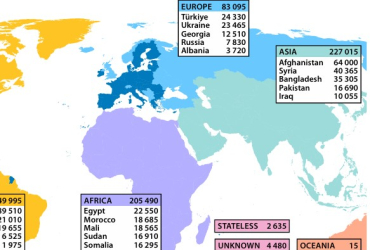
Asylum seekers seek protection outside the borders of their country of origin. The European Pact on Migration and Asylum sets out the European asylum procedures. The pact also determines which Member State is responsible for an application. The core principle of international protection is non-refoulement: no one can be returned to a country where their life would be at risk.
Someone who does not have, or no longer has, sufficient protection in their country of origin may be granted international protection in the EU. If someone has a well-founded fear of persecution because of their race, religion, nationality, political opinion or membership of a particular social group, they may be granted refugee status under the 1951 Refugee Convention. In that case, they are recognised as a refugee in the legal sense of the word. Subsidiary protection is available to people who do not qualify for refugee status but who would face a real risk of a life-threatening situation if returned to their country of origin.
Please note: the publications on this page are from July 2024 onwards. For earlier publications, please switch to Dutch (the EMN PDFs of the publications on the Dutch pages are in English). The filter below is in Dutch and will be available in English towards the end of 2026.
EMN study, EMN NL two-pager | International protection
EMN study on how EU Member States and EMN Observer Countries distribute accommodation centres for asylum applicants across their territory and how they cooperate with the local community.
EMN study: ‘Distribution of international protection accommodation centres and relationship management with local communities’
25 September 2025EMN study on how EU Member States and EMN Observer Countries distribute accommodation centres for asylum applicants across their territory and how they cooperate with the local community.
EMN study, two-pager EMN NL | International protection
EMN study into the possibilities in EU Member States for asylum applicants to have the decision on their application reviewed by a court.
EMN study: ‘Access to remedies for international protection applicants’
17 July 2025EMN study into the possibilities in EU Member States for asylum applicants to have the decision on their application reviewed by a court.
EMN study | Temporary protection
EMN research into the implementation of the Temporary Protection Directive (TPD). How was the TPD applied in EU Member States during the first half of 2023? What challenges did countries face, and are there any successes to share?
EMN study: ‘Application of the Temporary Protection Directive: challenges and good practices in 2023’
Update 30 January 2025, EMN Netherlands benchmark addedEMN research into the implementation of the Temporary Protection Directive (TPD). How was the TPD applied in EU Member States during the first half of 2023? What challenges did countries face, and are there any successes to share?
EMN NL AHQ | International protection
This information request (ad-hoc query)* concerns the validity period of initial and subsequent residence permits granted to beneficiaries of international protection, including both
Information request: ‘Validity of residence permits for international protection’
22 January 2025This information request (ad-hoc query)* concerns the validity period of initial and subsequent residence permits granted to beneficiaries of international protection, including both
EMN NL information request | Return, asylum
Information request (ad-hoc query)* on the detention of migrants from outside the EU/EFTA** and the application of the Returns Directive, the Reception Conditions Directive and the Dublin Regulation in EU Member States and EMN Observer Countries.
Information request: ‘Detention of third country nationals under the Returns Directive, the Reception Conditions Directive and the Dublin Regulation’
10 December 2024Information request (ad-hoc query)* on the detention of migrants from outside the EU/EFTA** and the application of the Returns Directive, the Reception Conditions Directive and the Dublin Regulation in EU Member States and EMN Observer Countries.
EMN inform | International protection
Research by the European Migration Network on existing governance models for the accommodation of asylum seekers in EU Member States and EMN O
EMN inform: ‘Governing the accommodation of third-country nationals’
3 December 2024Research by the European Migration Network on existing governance models for the accommodation of asylum seekers in EU Member States and EMN O
EMN study | International protection
EMN study on the instruments and procedures that EU Member States and EMN Observer Countries have in place to identify victims of torture and/or ill-treatment among applicants for international and temporary protection.
EMN study: ‘Practices and challenges in identifying victims of torture and/or ill-treatment in the context of international and temporary protection’
16 September 2024EMN study on the instruments and procedures that EU Member States and EMN Observer Countries have in place to identify victims of torture and/or ill-treatment among applicants for international and temporary protection.