
EMN research on the inclusion of digitally vulnerable applicants and the accessibility of regular migration procedures in EU Member States and EMN Observer Countries.
EMN inform, EMN NL two-pager | Regular migration
EMN inform: ‘Bridging the digital divide - Adapting digital services in legal migration procedures for accessibility and inclusion’
28 May 2026
Research period – until November 2025
Participating EU Member States – Austria (AT), Belgium (BE), Bulgaria (BG), Cyprus (CY), Czechia (CZ), Germany (DE), Estonia (EE), Spain (ES), Finland (FI), France (FR), Greece (EL), Croatia (HR), Hungary (HU), Ireland (IE), Italy (IT), Lithuania (LT), Luxembourg (LU), Latvia (LV), Netherlands (NL), Poland (PL), Sweden (SE), Slovenia (SI), Slovakia (SK)
Participating EMN Observer Countries: Norway (NO); Ukraine (UA)
Background and scope 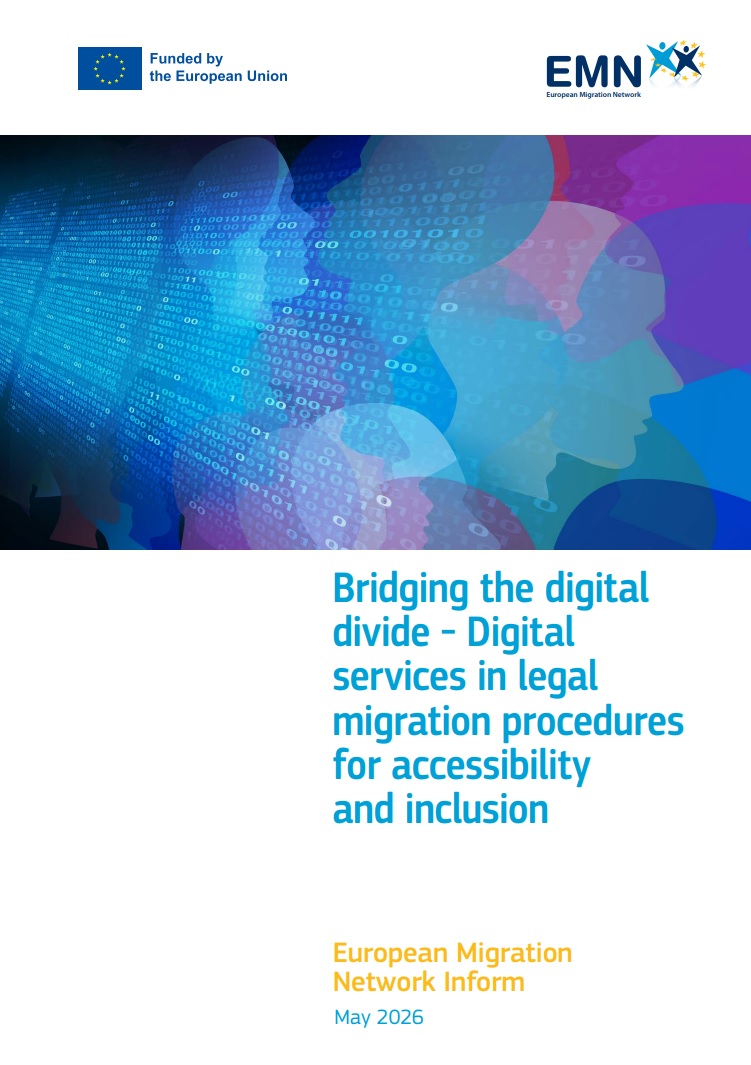
EU Member States are increasingly making use of digital government services in procedures for applying for regular residence permits. This can improve efficiency, transparency and user experience, but not for digitally vulnerable applicants.
- Digitally vulnerable applicants are for example persons with disabilities. Age, gender, language proficiency, literacy and education level can also play a role, as well as the availability and speed of internet in countries of origin, or the costs of mobile data.
- Digital services in residence permit applications must, in accordance with EU and international legislation, be accessible and inclusive to ensure equal access. This research maps the extent to which EU Member States and EMN observer countries comply with this.
- The research focuses on third-country nationals applying for residence permits via regular migration procedures, for example labour or study migration. Asylum seekers are excluded from the research.
EMN publications
- EMN inform, ‘Bridging the digital divide - Adapting digital services in legal migration procedures for accessibility and inclusion’, 12 May 2026
- EMN news item, New EMN inform examines digital inclusion and accessibility in legal migration procedures, 12 May 2026
EMN Netherlands publications
- EMN Netherlands two-pager (analysis from a Dutch perspective), 'Toegankelijkheid en inclusiviteit in de digitale diensten van reguliere migratieprocedures', 28 mei 2026
- News item, 'Residence permit applications are often digital – how do countries ensure accessibility?', 28 May 2026